Manufacturing decisions come down to performance: speed, accuracy, cost efficiency, and consistency. For years, plasma cutting dominated thick plate work simply because there were no viable alternatives. That has changed.
Advances in high‑power laser technology, particularly 12,000‑watt systems, now allow manufacturers to cut material up to 2 inches thick with cleaner edges, tighter tolerances, and faster throughput than plasma. What was once considered impossible is now routine.
The Advantage of 12,000‑Watt Laser Systems
A 12kW laser doesn’t just increase cutting capacity—it transforms production capability.
These systems handle:
- Carbon steel up to 40–50mm
- Stainless steel up to 30mm
Compared to 6kW equipment, thicker plate is processed two to three times faster, often in a single pass. Higher wattage also improves electrical efficiency, meaning more usable cutting power with less heat input and lower operating costs.
For shops working with heavy plate, this translates directly into higher productivity and fewer workflow compromises.
Cutting Up to 2″ Thick: A Shift Away From Plasma
For decades, material in the 2″ range belonged almost exclusively to plasma. Early laser machines simply didn’t have the power to compete.
That limitation no longer exists.
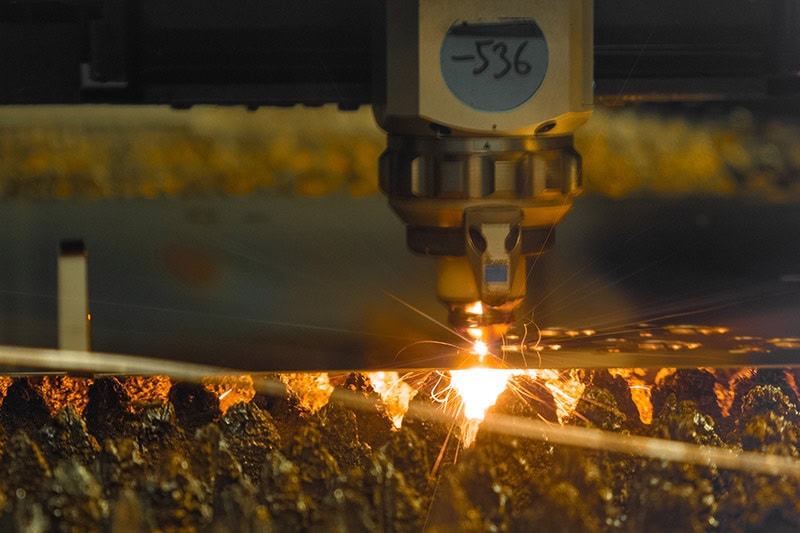
With 12,000 watts available at the cutting head, modern laser cutting systems can process 50mm carbon steel reliably—while producing a narrower kerf, smaller heat‑affected zone, and straighter edges than plasma.
Those differences matter downstream. Plasma‑cut parts often require grinding, dross removal, or edge correction before welding. Laser‑cut parts typically move directly to assembly, eliminating secondary operations and shortening lead times.
Fiber Laser vs Plasma Cutting: Key Differences That Impact Production
When evaluating fiber laser vs plasma cutting, the distinction goes beyond thickness capability.
Laser‑based cutting
- Square, perpendicular edges
- Tight tolerances and repeatable accuracy
- Minimal heat distortion
- No consumable wear during operation
- Superior nesting and material utilization
Plasma cutting
- Edge taper on thick material
- Wider kerf and larger heat‑affected zone
- Ongoing consumable replacement costs
- Edge cleanup often required
- Quality variation as consumables wear
For manufacturers supplying welded assemblies, cleaner edges and better fit‑up reduce welding time, filler usage, and rework—delivering real cost savings beyond the cutting table.
Precision That Improves Welding and Assembly
Accuracy isn’t just a specification—it’s a cost driver.
Laser‑cut parts routinely hold much tighter tolerances than plasma, making them ideal for:
- Bolt‑ready holes
- Zero‑gap assemblies
- Parts that must sit flush during welding
Plasma’s natural taper creates fit‑up challenges, forcing welders to compensate. Straighter edges simplify assembly, speed up welding, and reduce defects.
One Cutting Platform for Production and Custom Work
Modern fabrication demands flexibility. High‑power laser systems handle both:
- Large production runs
- Low‑volume or one‑off piece parts
Setup is fast and consistent. There are no torch swaps, consumable changes, or mid‑run recalibrations. Whether cutting one part or hundreds, quality remains identical from start to finish—making quoting more predictable and custom jobs more profitable.
Speed That Includes the Entire Process
Cut speed alone doesn’t tell the full story. What matters is how fast parts reach the next operation.
On thin materials, laser cutting dramatically outpaces plasma. On thicker plate, today’s 12kW systems match or exceed plasma speeds while eliminating cleanup and rework. When secondary operations are removed from the equation, total production time is often shorter—even when raw cut times appear similar.
Lower Cost per Part Over Time
While laser equipment carries a higher initial price, the cost per part often favors this technology:
- No consumables to replace
- Less operator intervention
- Improved material yield from tighter nesting
- Faster welding and fewer quality issues
Savings compound across cutting, handling, welding, and inspection—delivering long‑term operational advantages.
Why Fiber Laser Cutting Has Become the New Standard
The discussion has shifted from “Can this technology handle thick material?” to “Why rely on older processes at all?”
With modern 12,000‑watt systems, manufacturers gain:
- Faster throughput
- Cleaner, more consistent edges
- Reduced total production costs
- Greater flexibility for mixed workloads
The technology is proven, and the old limitations are gone.
Frequently Asked Questions
Fiber laser cutting is ideal for applications requiring precision, clean edges, and consistent results, especially when parts move directly into welding or assembly without secondary processing.
In many cases, yes. High‑power systems now cut thicknesses once reserved for plasma while delivering better edge quality and lower downstream costs.
Depending on material and setup, today’s equipment can cut up to 2 inches of carbon steel with consistent results.
Initial equipment costs are higher, but reduced consumables, labor, rework, and faster downstream processes often result in a lower total cost per part.
Choose laser technology when precision, consistency, material utilization, and total production efficiency matter more than rough‑cut capability.